_1730691017423.webp)

_1733827372956.webp "5 Aminolevulinic Acid Hcl")
5 Aminolevulinic Acid Hcl






CAS No.: 5451-09-2
Molecular Formula: C5H10ClNO3
Active ingredients:5-Aminolevulinic Acid HCL(5-ALA)
Specification: 98%
Appearance: White to light yellow powder
Test Method: HPLC
- Product Description
5 Aminolevulinic Acid Hcl – Premium Biochemical Raw Material for Agriculture, Cosmetics & Research
Rising demand for natural biostimulants and photodynamic active substances makes 5 Aminolevulinic Acid Hcl an essential raw material across agriculture, personal care and laboratory research. As a precursor of endogenous metabolites, it participates in chlorophyll synthesis to boost crop performance in agricultural applications. In cosmetic photodynamic formulas, it acts as the precursor for protoporphyrin IX. We supply multiple purity grades: agricultural grade 95–97%, as well as cosmetic and pharmaceutical intermediate grade 98–102%. This hydrochloride salt boasts excellent water solubility and stable batch quality to match diverse formulation demands.
Technical Specifications
|
Parameter |
Specification |
||
|
CAS Number |
5451-09-2 |
||
|
Molecular Formula |
C₅H₁₀ClNO₃ |
||
|
Molecular Weight |
167.59 g/mol |
||
|
Appearance |
White to off-white crystalline powder |
||
|
Purity (HPLC) |
Agricultural: 95.0–97.0%; Cosmetic/Pharma: 98.0–102.0% |
||
|
Loss on Drying |
≤1.0% |
||
|
Particle Size |
80–100 mesh, customizable |
||
|
Heavy Metals |
Pb<10 ppm, As<2 ppm, Cd<1 ppm, Hg<0.1 ppm |
||
|
Microbiology |
Total plate count <1000 cfu/g; E.coli & Salmonella: Negative |
||
|
Storage Conditions |
Sealed, light-proof; recommended storage temperature 2–8°C |
||
|
Shelf Life |
24 months |
||
| Test Item | Specification | Result | Test Method |
|---|---|---|---|
| Appearance | White to off‑white crystalline powder | Complies | Visual Inspection |
| Identification | IR / HPLC match reference standard | Positive | IR‑Spectroscopy / HPLC |
| Assay (on dry basis) | ≥98.0 % | 98.6 % | Titration / HPLCFUJIFILM W... |
| Loss on Drying | ≤1.0 % | 0.42 % | Vacuum Drying |
| pH (5% Water Solution) | 2.0‑3.5 | 2.71 | Potentiometry |
| Chloride Content | 20.5‑22.5 % | 21.4 % | Argentometric Titration |
| Related Substances‑Single Impurity | ≤0.50 % | 0.18 % | HPLC |
| Related Substances‑Total Impurity | ≤1.50 % | 0.57 % | HPLC |
| Sulfate (SO₄²⁻) | ≤50 mg/kg | < 20 mg/kg | Ion ChromatographySigma-Aldr... |
| Heavy Metals | |||
| ‑Lead (Pb) | ≤10 ppm | < 2 ppm | ICP‑MS |
| ‑Arsenic (As) | ≤2 ppm | < 0.5 ppm | ICP‑MS |
| ‑Cadmium (Cd) | ≤2 ppm | < 0.5 ppm | ICP‑MS |
| ‑Mercury (Hg) | ≤1 ppm | < 0.1 ppm | ICP‑MS |
| Residual Solvents | Meet ICH Q3C requirements | Complies | GC‑Headspace |
| Particle Size | Optional | ‑ | ‑ |
Why Choose Us
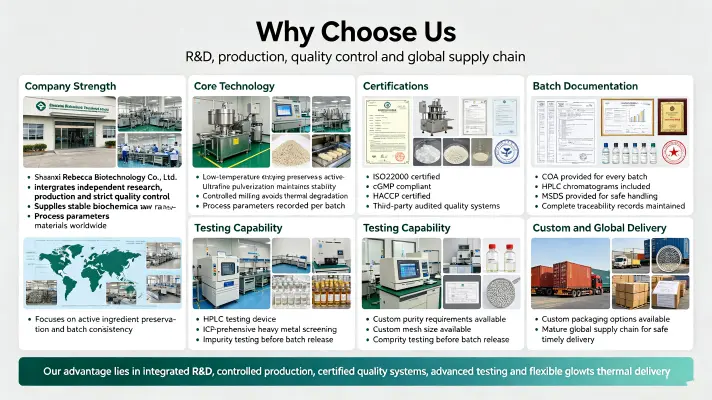
Shaanxi Rebecca Biotechnology Co., Ltd integrates independent research, production and strict quality control to supply stable biochemical raw materials.
We adopt low-temperature drying and ultrafine pulverization techniques to preserve active ingredients and maintain product stability.
Our facilities hold ISO22000, cGMP and HACCP certifications. Every batch comes with complete supporting documents including COA, HPLC chromatograms and MSDS.
Supported by a mature global supply chain, we arrange safe and timely delivery worldwide.
Custom services are available for special purity, mesh size and packaging requirements.
Equipped with HPLC and ICP-MS testing devices, we carry out comprehensive heavy metal and impurity testing to meet EU EC396 and EU 2023/915 regulatory standards.
Source & Traceability
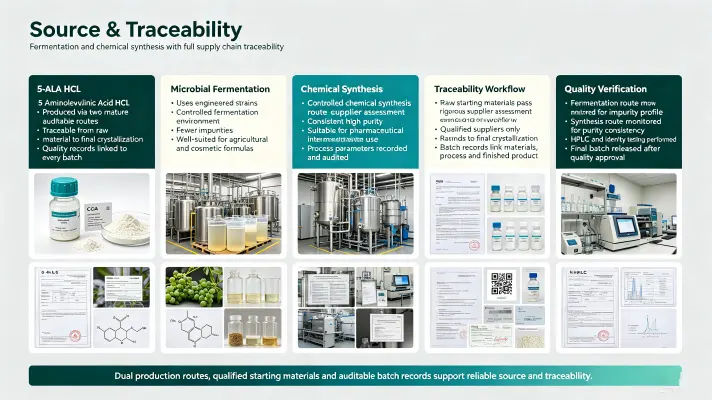
We produce 5 Aminolevulinic Acid Hcl via two mature, auditable routes: microbial fermentation using engineered strains and controlled chemical synthesis.
The fermentation process generates fewer impurities, making it well-suited for agricultural and cosmetic formulas.
Chemical synthesis delivers consistent high purity for pharmaceutical intermediate use.
All raw starting materials pass rigorous supplier assessment, with full traceability covering the whole production workflow from raw material input to final crystallization.
Solubility & Stability Profile
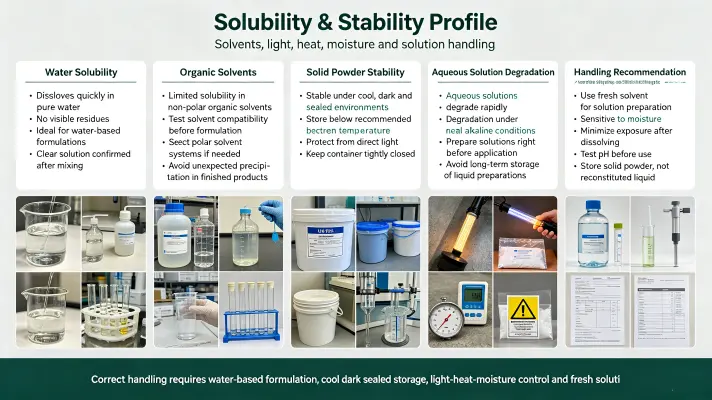
This substance dissolves quickly in pure water without visible residues, ideal for water-based formulations.
It shows limited solubility in non-polar organic solvents.
Stability testing confirms solid powder stays stable under cool, dark and sealed environments, yet it is sensitive to light, heat and moisture.
Aqueous solutions degrade rapidly under neutral or alkaline conditions. Prepare solutions right before application and avoid long-term storage of liquid preparations.
Manufacturing Process
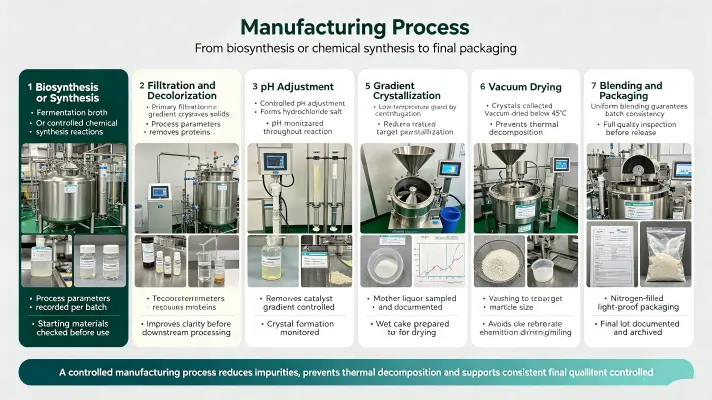
Production starts with fermentation broth biosynthesis or chemical synthesis reactions.
Primary filtration and decolorization remove proteins and catalyst residues.
Controlled pH adjustment forms hydrochloride salt, followed by low-temperature gradient crystallization to reduce related impurities.
Crystals are collected by centrifugation and vacuum-dried below 45°C to prevent thermal decomposition.
After crushing and sieving to target mesh size, uniform blending guarantees consistent quality batch by batch.
Each lot undergoes full quality inspection before nitrogen-filled light-proof packaging.
Quality Assurance
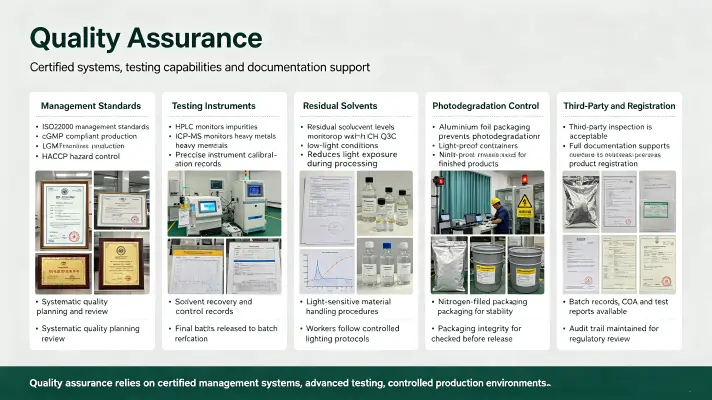
Production follows ISO22000, cGMP and HACCP management standards.
We use HPLC and ICP-MS to monitor impurities and heavy metals. Residual solvent levels comply with ICH Q3C requirements.
The whole production workshop maintains low-light conditions, and aluminium foil packaging prevents photodegradation.
Third-party inspection is acceptable, and full documentation supports overseas product registration.
Packaging & Delivery
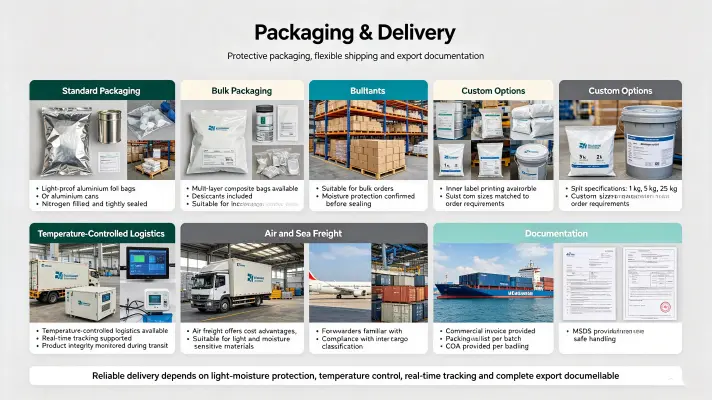
Standard packages adopt light-proof aluminium foil bags or aluminium cans, filled with nitrogen and tightly sealed to protect product quality.
For bulk orders, multi-layer composite bags with desiccants are available.
We support customised options including branded packaging, inner label printing and split specifications of 1 kg, 5 kg and 25 kg.
Temperature-controlled logistics with real-time tracking are available for transportation.
Air freight meets urgent delivery needs, while sea freight offers cost advantages for large-volume shipments.
All cargo is accompanied by commercial invoice, packing list, COA and MSDS.
We cooperate with forwarders familiar with relevant cargo classification to ensure compliance with international shipping rules.
Frequently Asked Questions
Q1: What is the difference between fermentation grade and synthetic grade?
A1: Fermentation grade contains fewer synthetic by-products and fits agricultural and cosmetic applications. Synthetic grade features higher purity and excellent batch repeatability, suitable for pharmaceutical intermediates.
Q2: Can you provide HPLC test chromatograms?
A2: Yes. Each batch is attached with COA containing HPLC spectra; third-party testing can be arranged on request.
Q3: What storage and shipping requirements should be followed?
A3: Products are packed in nitrogen-sealed, light-proof aluminium foil bags. Keep away from direct sunlight and high humidity during transit. Long-term storage needs to be maintained at 2–8°C.
Q4: What purity grades can you supply?
A4: Agricultural grade ≥95%, cosmetic grade ≥98%, pharmaceutical intermediate grade 98–102%. Custom specifications are negotiable for bulk orders.
Q5: Is customized particle size acceptable?
A5: Yes. The standard mesh size is 80–100 mesh. We can adjust particle size according to your formulation process.
Q6: What documents can you provide for customs clearance and registration?
A6: We supply COA, MSDS, HPLC spectra, certification copies and other materials to support import registration in different regions.
Contact Us for 5 Aminolevulinic Acid Hcl Inquiries
Our sales and technical team can offer professional product guidance and formulation suggestions. Whether you need standard specifications or tailor-made solutions for 5 Aminolevulinic Acid Hcl, we provide reliable support throughout your cooperation.
Please reach out to information@sxrebecca.com to discuss your demands and get formal quotations.