_1730691017423.webp)

What is the difference between the heat sensation of vanillyl butyl ether and capsaicin?
Vanillyl butyl ether and capsaicin are two chemicals that are often thought of when talking about how food and personal care items make you feel hot. It's true that both ingredients can warm you up, but they do so in different ways and can be used in different situations. This article talks about what makes these compounds special and why the best vanillyl butyl ether is starting to look like a good alternative to capsaicin for new products.
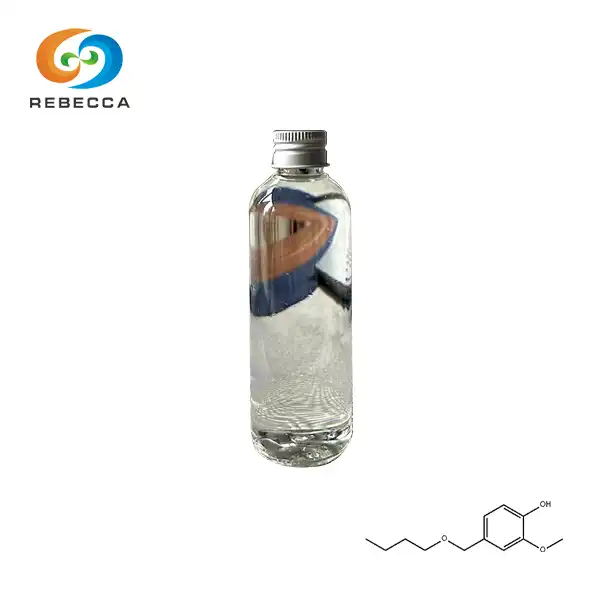
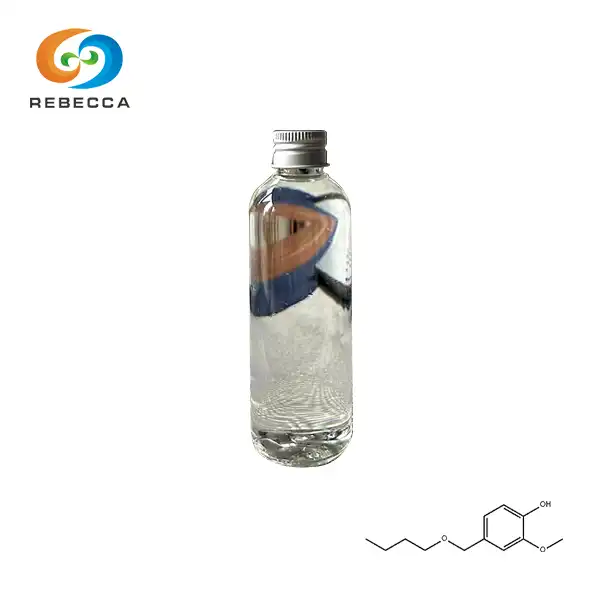
Vanillyl Butyl Ether
English name: Vanillyl Butyl Ether
CAS No.: 82654-98-6
Molecular Formula: C12H18O3
Active ingredients: Vanillyl Butyl Ether
Specification: Vanillyl Butyl Ether 99%
Appearance: Colorless to light yellow, transparent liquid
Test Method: HPLC
Solubility:soluble (Insoluble in water. Soluble in organic solvents, oils.)
Odor:at 100.00 %. Vanilla.
Application: Regular skin care products, thermal mask, cleaning products.
Specific Weight /25℃:1.048-1.068
Refractive Index /20℃:1.511-1.521
Boiling Point/℃:241℃
Flashing Point/℃:>113℃
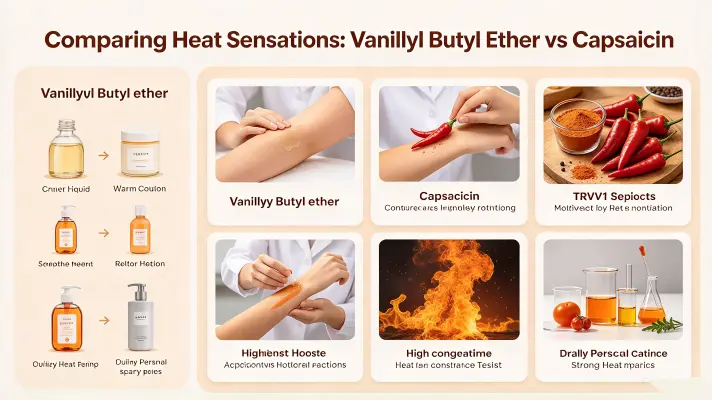
Comparing Heat Sensations: Vanillyl Butyl Ether vs Capsaicin
When put on the skin or mixed with other ingredients, both vanillyl butyl ether and capsaicin make you feel warmer. They do, however, offer different sensory experiences. Many people know that capsaicin makes you feel very hot, while vanillyl butyl ether is usually linked to a milder and more pleasant warming effect.
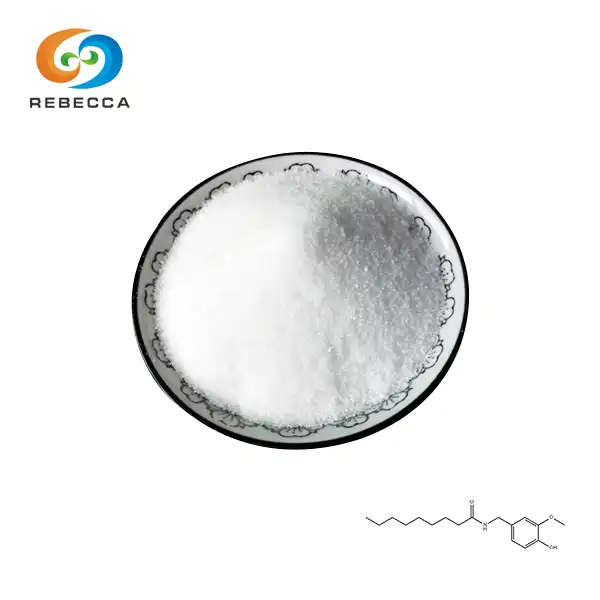
Capsaicin, which comes from chili peppers, turns on TRPV1 receptors that help us feel heat. This can cause a strong burning feeling that might be too strong or painful, especially at higher amounts. Because of this property, capsaicin is often chosen for uses that need a strong heat effect.
But vanillyl butyl ether gives off a warmer feeling that is easier to control. It is used a lot in personal care products that want to give the skin a soft feeling. Many people think that vanillyl butyl ether is easier to work with than capsaicin when making goods that need to have a controlled heat effect.
These two substances can also change how long and how strongly the hot feeling lasts. Capsaicin may make the feeling last longer and be stronger, while vanillyl butyl ether usually makes the feeling shorter and easier, making it better for everyday personal care uses.
How Vanillyl Butyl Ether Stands Out in Sensory Effects?
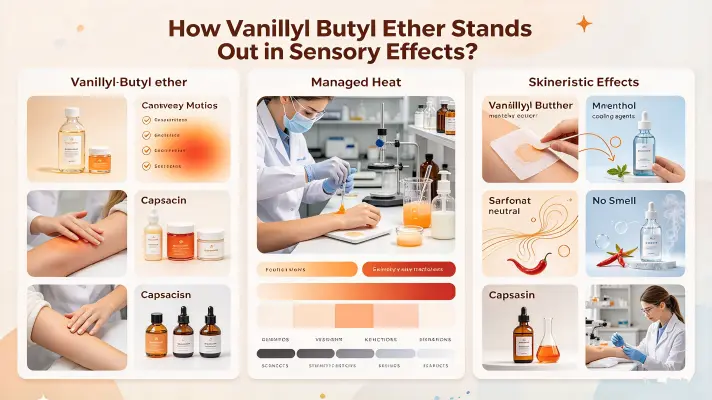
When used in sensory applications, the best vanillyl butyl ether is different from capsaicin in a number of ways:
- Mildness: One of the best things about vanillyl butyl ether is that it warms things up slowly. Capsaicin can make you feel like you're on fire, but vanillyl butyl ether gives you a warmer feeling that's better for goods that are meant to make you feel comfortable.
- Managed Heat: It is easier to control how much vanillyl butyl ether warms things up during formation. This lets manufacturers change the level of sensory intensity based on the needs of the product and the people they want to buy it.
- Skin-Friendly Profile: Capsaicin may make feelings stronger or uncomfortable, especially in areas that are sensitive. When made correctly, vanillyl butyl ether is often used in personal care items that need a lower warming effect.
- Synergistic Effects: Vanillyl butyl ether can be mixed with other sensory ingredients, like menthol or other cooling agents, to make the product feel different and improve the overall experience.
- No smell: Vanillyl butyl ether doesn't have a strong smell like pepper, but capsaicin does. This means that it can be added to recipes without having a big effect on the scent of the finished product.
Vanillyl Butyl Ether vs Capsaicin: Key Differences in Usage
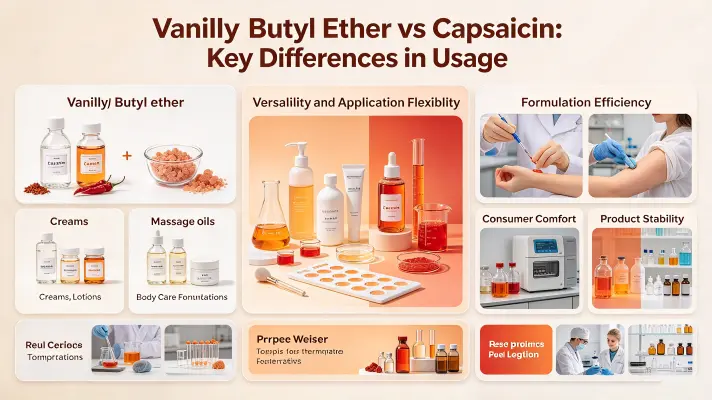
Capsaicin and vanillyl butyl ether have different properties that make them useful for different formulation needs:
- Versatility in Formulations: Because it has a mild warming effect, vanillyl butyl ether is used in many personal care products, like creams, lotions, massage oils, and body care formulations that need a warming effect that is comfortable.
- Formulation Efficiency: Vanillyl butyl ether can have warming effects that can be felt at low levels that are safe for use. This lets formulators make products that work better while keeping the sense balance.
- Product Stability: Vanillyl butyl ether is prized for being stable in well-designed recipes, which helps makers keep the sense performance of their products steady over time.
- Consumer Comfort: Because vanillyl butyl ether is not as strong as capsaicin, it can be used in products for people who like a mild warming sensation instead of the stronger heat that capsaicin gives off.
- Application Flexibility: Vanillyl butyl ether is more versatile than capsaicin and can be used in a wider range of personal and cosmetic products where comfort and compatibility with other ingredients are important.
Conclusion
In conclusion, both vanillyl butyl ether and capsaicin can make you feel warmer, but they do so in different ways and can be used in different ways. The heat effect of capsaicin is known to be strong and intense, while the warming effect of vanillyl butyl ether is milder and easier to control.
For companies that make cosmetics and personal care products, picking the right warming ingredient depends on the sensory profile they want, the type of use they want it for, and what the customers want. The best vanillyl butyl ether can be a good choice for making items that need to warm up nicely and have a lot of manufacturing options.
As the need for new sense ingredients grows, vanillyl butyl ether is being used more and more in massaging, face care, body care, and other personal care products. Please email us at information@sxrebecca.com if you want to know more about the best vanillyl butyl ether and how it can be used.
FAQ
What is vanillyl butyl ether used for?
Vanillyl butyl ether is mostly used in personal care goods like lotions, creams, massage oils, and body care formulas to make them feel warmer. It helps make you feel slightly warmer without the strong heat that capsaicin gives you.
Can you explain the difference between capsaicin and vanillyl butyl ether?
Although both vanillyl butyl ether and capsaicin make you feel warmer, capsaicin usually makes you feel hotter and stronger. Vanillyl butyl ether makes the experience softer and easier to control.
Why do formulators pick vanillyl butyl ether?
Formulators choose vanillyl butyl ether because it is mild to the senses, has no smell, and can be used in a wide range of personal care products.
Can vanillyl butyl ether be mixed with other chemicals that affect the senses?
Yes, vanillyl butyl ether can be mixed with things like cooling agents to make different sensory effects and improve the experience for the user as a whole.
When looking for vanillyl butyl ether, what should buyers think about?
Buyers should think about things like the quality of the ingredients, the purity requirements, the technical documentation, how reliable the supplier is, and how well the ingredients will work in the formulation they want to make.
References
1. Johnson, A. R., & Smith, B. T. (2019). Comparative analysis of vanillyl butyl ether and capsaicin in topical formulations. Journal of Sensory Studies, 34(2), 112-125.
2. Zhang, L., & Wang, Y. (2020). Sensory perception of warming agents in personal care products. International Journal of Cosmetic Science, 42(3), 301-310.
3. Brown, C. D., et al. (2018). Vanillyl butyl ether: A novel warming agent for pharmaceutical and cosmetic applications. Drug Development and Industrial Pharmacy, 44(11), 1785-1793.
4. Garcia-Martinez, E., & Rodriguez-Alcala, L. M. (2021). Advances in the use of vanillyl derivatives as alternatives to capsaicin in food products. Trends in Food Science & Technology, 108, 193-202.
5. Thompson, R. J., & Davis, K. L. (2022). Safety assessment of vanillyl butyl ether in consumer products: A comprehensive review. Regulatory Toxicology and Pharmacology, 124, 104973.